Journalist Joshua Hammer sprak op de Dag van het Grote Verhaal, een conferentie van de Stichting Verhalende Journalistiek op 19 september 2014, over hoe hij succes had als vaste redacteur van Newsweek. En hoe hij succesvol is als freelancer. Bij National Geographic vangt hij 3 tot 5 dollar per woord. Dat krijg je in Nederland niet, ook niet van hetzelfde blad. Ik maakte een verslag van zijn lezing.
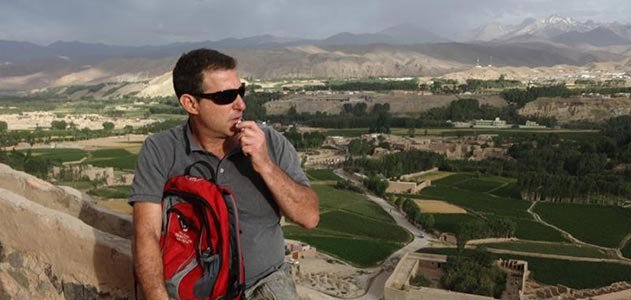
First I will tell you something about my own background. Everybody said I made a stupid choice leaving Newsweek. In 2006 the magazine experienced its last gasp of success and I had worked eighteen years at the magazine by then. I have been a foreign correspondent in Nairobi, Buenos Aires, Berlin, Jerusalem and Cape Town. But the work for Newsweek was feeling repetitive and formulaic. It was time for something different. I wanted out. I got kicked out of Newsweek, because I wrote a story for The New Yorker. But I did not get a contract there, so I became a freelancer. At first it was scary. Suddenly you’re out there in the wilderness. Occasionally I had written long-forms for different magazines, and I had a name and network as a Newsweek foreign correspondent. So I made it work as a freelance journalist.
Sometimes ideas and good stories are very serendipitous.
The US market is very different from the Dutch market. The market in the United States is very dynamic and you can make a good living as a freelancer. There are some magazines that pay three to five dollars a word, such as National Geographic and Vanity Fair. The United States also maintains a narrative long-form industry. There are twelve publications in the US that support long-form, so the market is there.
Now let me give you a few guiding principles that have helped me selling stories.
First, finding the right idea. Seventy-five percent of my stress involves finding the idea. Where do you begin, where do you come up with this stuff? When I finish a piece I take days for what I call a ‘binge search’: where’s that next idea going to come from? I read all the publications, English, French, German, online. I get ideas through conversations, by socializing. Sometimes ideas and good stories are very serendipitous. I was in Lebanon, for example, for Smithsonian Magazine, writing a profile of this torn up country, and I got an idea to write about Rafik Hariri’s assassination for the Atlantic Monthly.
Second, what makes a good story? Scenarios that sell are crime and punishment stories, about justice and resolution. That can be political crime, but also personal crime stories that contain a universal principle that everybody can relate to. That is something that will sell. I also like profiles, mainly about how the mighty have fallen.
Third, how do you sell it? The pitch is critical. I have developed a method of a little bit of reading and calling just a few sources. My serious advice is: don’t spend a lot of time on it. Send a one-paragraph email to editors. That will attract attention. If you get a positive reaction write a four or five paragraph pitch. A few sentences to grab attention, a few sentences summarizing what you know and a larger meaning or implication paragraph. Editors love larger meanings.
Fourth, you are not just selling the idea, but you are also selling yourself. So establish an identity for yourself. Create your own brand, then your name speaks to people. I am a writer of foreign affairs. That has been helpful in forming my identity, but it is limiting as well. But it is very hard to be a generalist. If you have a specialty, if you can brand yourself, I advise you to do it.
Fifth, establish a connection to an editor. A personal and professional relationship with one or two editorial connections makes a huge difference.
Sixth, bundling as a strategy. Editors don’t like to spend money, so, for example, I scrambled ideas that I could bundle during my stay in Birma. My flight had been paid, I was going to be there for a couple of weeks. So I called other editors if they were interested in a travel article about Birma and a business story about Birma. In the end it was a very fruitful trip. Think about what else you can get out of a trip.
Finally, match ideas to publications. So for Smithsonian I write stories that have an edge to them, but are also upbeat.
It’s a scramble and it’s tough, but I hope I have given ideas about how it can work.